Content Syndication: What It Is and How It Works
Content Syndication
Updated on November 3, 2025
In a crowded digital marketplace, standing out requires more than just producing great content — it’s about getting it seen.
Content syndication helps you do exactly that by republishing existing content across trusted third-party platforms to amplify reach, awareness, and SEO performance.
This guide explains what content syndication is, how it works across industries, and how it applies specifically to eCommerce brands.
What’s in the Article:

Content syndication definition and use cases.
How it differs in eCommerce vs media and B2B lead gen.
Channels: news, social, paid, and product content.
Risks and best practices for attribution and SEO.
What is Content Syndication?
Content syndication means republishing the same content across multiple websites other than where it originally appeared.
Broadcast media has used this tactic for a long time. It started with TV, where different networks aired the same shows. Today, it’s a powerful way to share content like articles, videos, and blogs online.
By uploading content to relevant partners, many sites can access your media. It’s a way to reach your target audience beyond your existing customer base.
Benefits of Content Syndication
Content syndication benefits eCommerce marketers who want to strengthen their online presence. Brands can use this strategy to distribute content, improve conversions, and help customers remember their products.
Here’s how syndication can transform your marketing efforts:

Wider Reach: Digital content syndication puts your brand in front of a wider target audience.
SEO Boost: Sharing content across reputable platforms can improve your rankings on search engine results pages (SERPs).
Time Efficiency: Leveraging existing content reduces the time to publish.
Cost-Effectiveness: Syndication can be more cost effective than creating new content for eCommerce platforms.
Authority Building: Syndicating content on platforms with established audiences can enhance site authority.
Syndicated content can boost website traffic and increase audience engagement for some brands. This strategy saves time and ensures content is seen by your target audience.
How Content Syndication Works
In marketing, content syndication is when a brand shares content on multiple channels.
For example, in journalism, newswires syndicate content with different publications. This practice is also important in social media, paid media, and eCommerce.
The process starts when a publisher creates content, like articles, blog posts, or videos.
This content is then republished to other sites, like blogs, social media sites, news outlets, or web-based platforms. The goal is to increase visibility and reach among the target audience.
This benefits both the original publisher and the third-party sites. The publisher gains more exposure, while its content syndication partners gets fresh content to engage its audience and improve its SEO.
Understanding how content syndication works across different platforms is important. Read on to explore the processes involved.
Common Types of Content Syndication
Syndication takes different forms depending on your goals and audience. Here are the main categories used today:
News Feed Syndication
News feed syndication is a staple in journalism. Major news organizations like AP and Reuters compile articles and distribute them to various news websites.
It helps share information so that current events reach a global audience.
Social Media Syndication
Social media syndication allows you to repurpose and distribute posts across platforms like LinkedIn, X, Instagram, and YouTube automatically. It helps maintain message consistency while reaching different audiences in their preferred channels.
Paid Native Syndication Networks
Paid content syndication networks operate on a fee-based model. You can publish your content across a network of sites by paying a fee. This is also sometimes referred to as native advertising.
Publishers label this content as sponsored to ensure transparency. Common paid content syndication networks include Outbrain, Taboola, Dianomi, and the Google Display Network.
B2B Lead Generation Syndication
In B2B marketing, syndicating eBooks or reports on partner portals helps generate qualified leads. These platforms often promote your content to segmented audiences already interested in your topic.
Product Content Syndication (for eCommerce)
In eCommerce, content flow is constant. Brands regularly create and update content like product pictures, descriptions, and videos.
This content helps with branding and keeping products updated and fresh for customers.
The traditional process has inefficiencies. Brands send their latest content with specific go-live and takedown dates, but retailers must update each product page.
Your Content at 350+ Online Shops Worldwide
Product Content Syndication for Brands

Multiply Revenue Across Retailers
Optimise your ROI per content piece by syndicating content to multiple retailers simultaneously.
Consistent Content Everywhere
Eliminate outdated content for good! Set go-live and takedown dates so you can stop chasing your retail-side counterparts.
Publish and Update Instantly
Publish and update content with a single click. Make one change and publish it everywhere the content is live.
This method is error-prone and time-consuming. The result? Missed deadlines, outdated content, and wasted resources. For retailers with many product pages, it’s overwhelming and delays current content, hurting sales and customer trust.
The good news is there’s a better way. Modern product content syndication platforms can automate content distribution and updates across many retailer platforms, including retailer PDPs.
These platforms keep the latest content live without manual work. This saves time and ensures customers have the most up-to-date product information.
Learn more about the benefits of this innovative approach to eCommerce publishing in our article on product content syndication.
Product Content Syndication with DemoUp Cliplister
For online shopping, sharing product information with customers is crucial. DemoUp Cliplister’s product content syndication software leads this revolution.
Brands can upload videos, images, 3D models, and augmented reality experiences. With a network of over 450 retailers, the software automatically publishes content to all relevant PDPs.
Retailers that join as a content syndication partner can add over 300,000 videos and 3D models to their product pages.
Our advanced software matches content to the correct product pages using EANs. It places visual content in the image gallery above the fold, where it is most visible to customers.
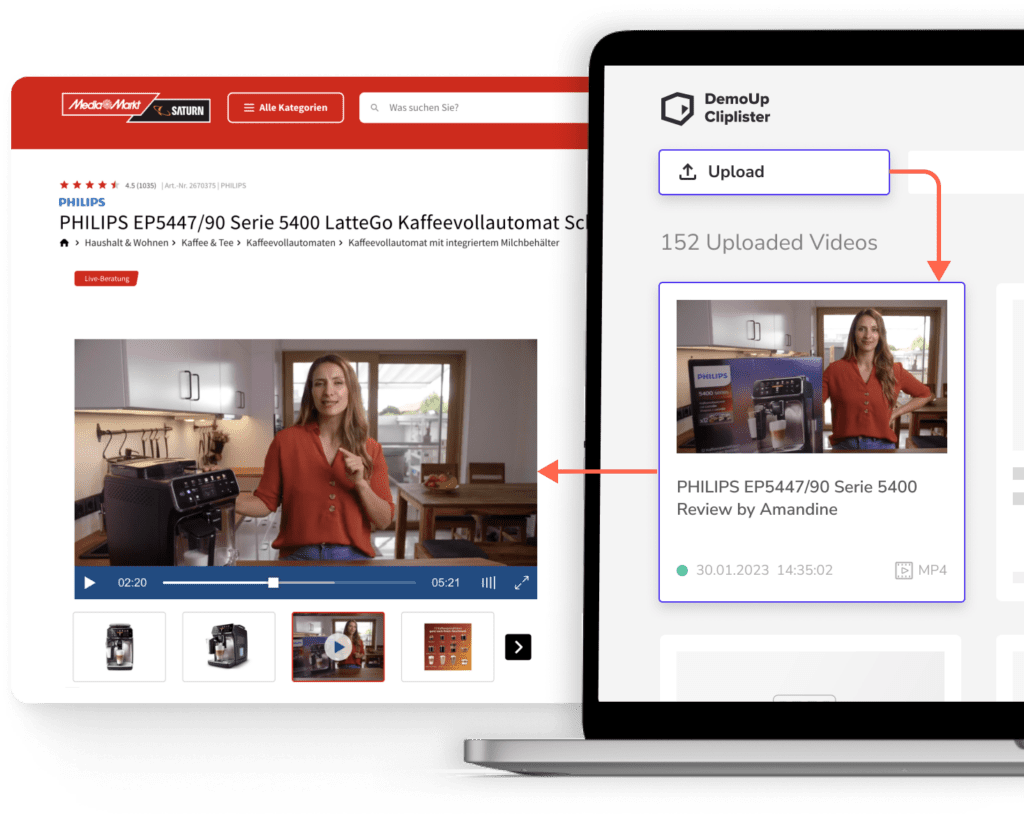
Automating this process improves presentation, increases sales, and enhances the customer experience. Brands and retailers using our services see significant revenue increases.
For brands, shoppers are happier with better product information to help them decide what to buy.
Retailers get better content coverage and automatic updates. This removes discrepancies from outdated information.
This approach benefits everyone. Brands get control and consistency. Retailers get automatic updates. Customers get reliable, detailed information.

Are your partners connected?
Find out if your biggest brand or online shop partners are part of the DemoUp Cliplister network!
Why B2B Content Syndication is Essential for eCommerce
In eCommerce, B2B content syndication is a must. Creating high-quality content can be expensive and time-consuming.
For example, a video that costs £5,000 to produce becomes more cost-effective when shared with multiple retailers. If ten retailers use the video, the cost per retailer is just £500. The more retailers you share it with, the lower the cost per retailer, boosting your overall ROI.
Note: To see which retailers are in our network, book a call and we’ll provide a list.
Syndicated content also lets brands control their content on the product pages of major retailers. This is crucial for keeping a consistent brand message, which builds customer trust and loyalty.
Content syndication helps brands reach more customers. Brands can reach more of their target market without making new content for each site. This saves time and keeps your message consistent everywhere.
In short, joining a content syndication network helps brands maximise reach while minimising effort and cost. Which helps your brand stand out online using your existing content.
Exclusive Content From 3,000+ Brands
Product Content Syndication for Online Retailers
300,000+ Videos & 3D Models
Access 300,000+ product videos, interactive 3D models, augmented reality experiences, and more.
Improved Content Coverage
Easily improve video and 3D coverage in your online shop. Boost conversions and make more sales.
Continuously Updated Content Pool
Get the most recent and up-to-date content integrated into your website automatically.
Syndicated Content in the Online Marketplace
In the online marketplace, content syndication comes in various forms, each serving a specific purpose for consumers. Syndicated content can include videos and product data feeds.
In the following sections, we will explore each type in detail, discussing their importance and how they improve the buyer experience.
Product Videos
Product videos are crucial for online shopping as they show what the products look like. They are especially effective for explaining complex features or demonstrating products in action.
For consumers, this visual context can be the deciding factor in the purchasing process. These videos can increase conversion rates because buyers can see exactly what they’re getting. They offer a dynamic alternative to still pictures.
For more insights into the power of product videos, visit our article on product videos.
3D & AR Models
Online shopping is evolving with 3D eCommerce, making online shopping more interactive. Customers can scan QR codes to see products in their space, blending online and in-store shopping.
While many brands create such content, implementation can be challenging for retailers.
Our software simplifies this process, benefiting both parties. To see our capabilities in creating these models, check out our work.
Types of Syndicated Product Content
Product Videos
3D & AR Models
360-Degree Spin Views
Review Videos
Awards & Quality Seals
Product Data & Specs
Customer Reviews
Customer reviews, in text or video format, are crucial for building trust and credibility. Potential buyers value honest opinions from other users, which can influence their purchasing decisions.
Our review video production service is cost-effective, syndicating finished projects directly to the point of sale, saving 80% compared to traditional influencer marketing.
This offers a genuine and affordable way to gain customer trust.
Awards & Quality Seals
Awards and quality seals on product pages show that respected third parties believe the product is safe and high-quality. These accolades are influential in the customer’s decision-making process.
Experts vet and rate products, providing social proof. These symbols help brands gain consumer trust and stand out in a crowded marketplace.
Product Data, Descriptions, and Specifications
Syndicating product information, descriptions, and specifications is standard in eCommerce, and is done through product data feeds.
Customers can learn everything they need to about a product, helping them make smarter purchases. However, this alone isn’t enough.
Brands must add valuable content that covers the entire buying process. Demonstrating value is crucial. Businesses should offer real product experiences, including user-generated content like reviews and testimonials.
How to Build an Effective eCommerce Content Syndication Strategy
An excellent eCommerce content syndication strategy helps your brand reach a wider audience and build brand recognition on different platforms. This strategy conserves resources and creates a cohesive brand narrative.
Follow these steps to create a strong content syndication framework that matches your marketing goals and stands out.
1. Create Awesome Content
The saying “content is king” holds especially true in syndication.
Start by creating content that captivates and educates your audience. It should reflect your brand and communicate your message.
Your content must stand out, whether it’s high-quality images, informative videos, or engaging descriptions.
2. Evaluate Syndication Partners
The success of your content syndication depends on the partners you choose.
To find the right content syndication partners for your brand, research the type of content they syndicate and the websites in their network.
Consider the reach, reputation, and relevance of potential partners. Using a mix of networks can optimise coverage and impact.
Each network has unique strengths, such as amplifying reach, targeting niche markets, or specific content types and placements.
3. Choose Your Channels
After identifying potential syndication partners, select your channels. Analyse where your content will have the most impact.
Also consider your target audience. Think about the type of content they engage with, and their geographical location if targeting specific markets. Localising content for different regions increases its effectiveness.
Keep in mind how your goals affect channel selection. For awareness, include social media channels. For conversions, focus on PDP content.
4. Maintain Consistency
Consistency in content syndication means keeping a uniform brand voice and coherent messages across all platforms. This builds a reliable and trustworthy brand image.
It also simplifies content management and helps your team track content syndication efforts while increasing brand recognition among consumers.
Consistent product communication reinforces your brand’s values and strengthens your connection with your audience, which is crucial for long-term engagement and loyalty.
5. Promote Your Content
Promote your syndicated content strategically. Use social media to tease content, create buzz, and drive traffic.
Short, engaging trailers of product videos can generate interest, and snippets from review videos can showcase the customer experience.
Use multiple channels to reach more people, but be strategic. Not every piece of content suits every channel.
Aim to create a seamless omnichannel experience that guides the consumer from social media to detailed content on PDPs.
6. Track and Analyze
Track and analyse your content’s performance across all platforms. This data reveals what resonates with your audience and what doesn’t.
Understanding customer interactions helps you spot patterns and trends for future strategies. Our platform provides detailed analytics, including views, attention spans, and more. Both brands and retailers can use this data to make informed decisions.
7. Adjust With Data
Adjust your strategy based on data. Analyse metrics to understand customer engagement. Look at view rates, attention spans, and repeat views to identify what works and what needs improvement.
Use this data to tweak and optimise your content. Continuous analysis and adjustments based on consumer behaviour and performance metrics are crucial for staying competitive in eCommerce.

Find out how AEG scaled product videos to thousands of PDPs.
Read the case studyWrapping Up
B2B content syndication is essential for eCommerce companies that want to reach a broader audience and boost consumer engagement.
We offer complete eCommerce content solutions to help brands and shops streamline their strategy and grow.
Learn how we can accelerate your eCommerce growth by visiting our homepage.
Frequently Asked Questions
Content syndication can be complex. This section answers common questions and provides insights.
Digital content syndication is distributing and sharing digital content, such as movies, 3D/AR models, or product reviews, across another online platform or third-party website in the eCommerce industry.
Yes, content syndication is worth it for most businesses. Instead of creating one piece of content, manually asking for it to be implemented, and following up over time with updates, brands can control which pieces of content go where themselves.
It offsets the cost of content creation, improves reach, and multiplies revenue across endpoints where buyers are looking for reassurance and trust signals.
Content syndication platforms connect content creators (in eCommerce terms, brands) with publishers (retailers). Brands upload content, and retailers republish and share it with their audiences.
It expands content reach, increases conversions, and allows brands to implement attribution to each piece of content at a retailer. Performance is tracked, and other agreements may be in place.
There are several benefits of syndication. Brands can always have the most relevant content at their most important shops, update content, and remove expired content.
So, retailers always have a large pool of content to pull from, which increases content coverage, boosts add-to-cart conversions, and leads to more revenue by providing users with the information they want at the point of sale.
There are several types of syndication, but the main types are paid networks, news feeds, social media, and eCommerce.
You can see more about the different types of content syndication in the how syndication works section of this article.

Better Content. More Sales.

Fill out the form to discover our end-to-end eCommerce content solutions for brands & shops